
By Matthew Beer, Founder and CEO, King Safety and Security (KSS). November 2026.
A residential security assessment should leave a household with a clear picture of how it could be targeted, and a short, prioritized list of what to do about it. In the Greater Toronto Area, that means looking well beyond locks and cameras: at the property, the people who come and go, the family’s routines, what can be found about them online and the vehicles on the driveway.
This guide sets out what a good assessment covers, what you should receive at the end and how to judge whether it has been done properly.
Start with the household, not the headlines
Police-reported crime in Canada fell in 2025. Statistics Canada reported that the national Crime Severity Index dropped 5%, the rate of breaking and entering fell 11% and motor vehicle theft fell 16% (Statistics Canada). Toronto’s Crime Severity Index fell 7% (CP24).
City-wide figures hide a great deal. Toronto police recorded 6,092 break-and-enters in 2025, 11% fewer than in 2024, yet some of the highest rates per resident were in neighbourhoods such as Rosedale-Moore Park, Bridle Path-Sunnybrook-York Mills and St. Andrew-Windfields (Narcity, using Toronto Police Service data). In Rosedale, residential break-ins rose by nearly 30% in 2025 (CTV News).
So the useful question is not whether crime is going up or down. It is how exposed this family, at this address, actually is. That is what an assessment should establish.
What the assessment should cover
1. The approach and the perimeter
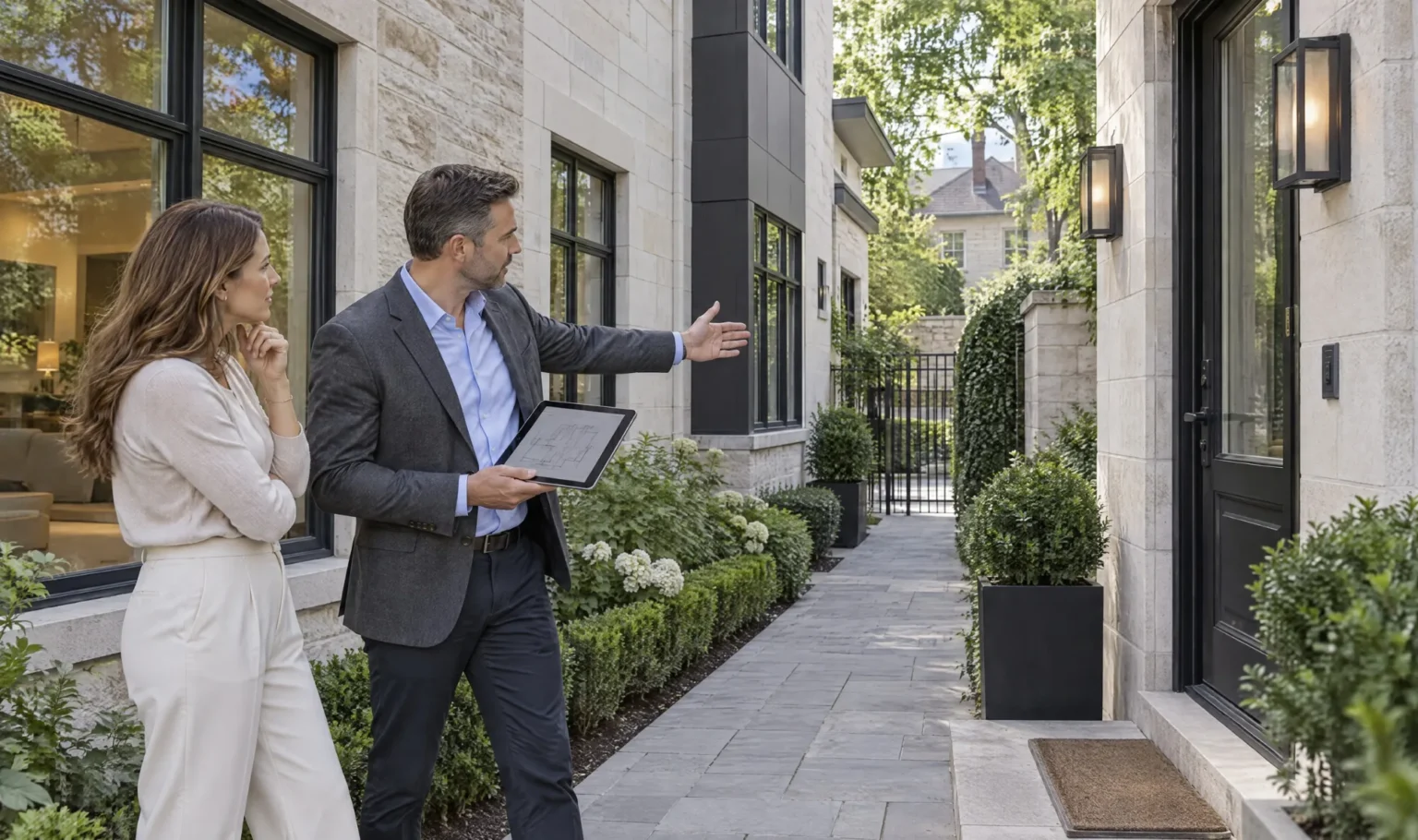
How the house is seen and reached: from the street, from neighbouring properties, laneways, a ravine or park behind the lot. Gates, driveways, lighting, landscaping that gives cover, and what someone watching the house could learn about who is home.
2. Doors, windows and the building itself
Every way in, including garage, side and basement doors, balconies and glazing that can be reached from outside. Whether the household has somewhere stronger to retreat to, and whether a secure room is justified at all. See Secure Doors, Windows and Safe Rooms.
3. Alarms, cameras and response
What is monitored and by whom, what actually happens when the alarm sounds at three in the morning, who responds and how long it takes. Whether cameras capture faces and plates, who can view them remotely, and whether anyone has tested the system recently.
4. Vehicles and the driveway
In the GTA, vehicles have been a target in their own right: in early 2024, Toronto police reported that carjackings had more than doubled compared with the same period a year before (CTV News). Vehicle theft has since fallen, but a high-value vehicle on a driveway still changes a home’s exposure. The assessment looks at where vehicles are kept, how keys and fobs are stored, and whether a vehicle could draw someone to the door.
5. People and access
House managers, nannies, cleaners, contractors, drivers, dog walkers and deliveries. Who has keys and codes, how they were vetted, what they would do if approached, and whether access is withdrawn when someone leaves. In Ontario, police record checks need the person’s consent and come in three types (Ontario).
6. Routines and predictability
School runs, regular appointments, staff schedules, and the times the house is empty. Long winter absences are common for Canadian families, and an empty house in January carries different risks from an occupied one.
7. Online exposure
What a motivated person could learn without leaving their desk: the address from property or company records, photos and floor plans left online from a previous sale, children’s schools, and posts by family members, friends and staff. See Digital Risk and Protective Intelligence.
8. What happens if something goes wrong
A plan for an intrusion while the family is at home: who calls whom, where people go, what staff do, and how the family is supported afterwards.
What you should receive
- A written report, ranking findings by priority and explaining the reasoning behind each one
- Quick improvements that cost little, separated from those that need investment
- Proportionate options where more protection is justified, such as a residential security team, better response arrangements or physical upgrades
- Equally clear advice on what is not worth spending on
- A debrief with the family or family office, and a date to review the findings
How to judge an assessment
- Is it independent? An assessor who also sells the alarms, cameras or guards being recommended has a conflict of interest, and should at least declare it.
- Does it cover people and online exposure, or only hardware?
- Was the property visited in person, ideally at different times of day?
- Is the report itself handled securely? It is a map of the household’s weaknesses.
Toronto police also offer Crime Prevention Through Environmental Design audits of homes, which are a useful look at the physical environment (CTV News). A private assessment goes further, into the household’s people, routines and online exposure, and into what to do about them.
How KSS Canada approaches it
A residential security risk assessment is the most common way clients begin working with us in Canada. It is independent of any product, and the recommendations are proportionate to what we find. If the family wants help putting them in place, we can do that or oversee the people who do.
Arrange a confidential consultation.
FAQs
What is a residential security assessment?
An independent review of a home and the household around it: the property, the people with access, the family’s routines, its online exposure and its plans for an emergency, ending with prioritized recommendations.
Is it only for large estates?
No. Condominiums, townhouses and family homes all benefit, and condominiums bring their own questions about shared entrances, parking and building staff.
We already have an alarm and cameras. Do we still need one?
Often, yes. Technology is only as good as the response behind it, and many of the risks an assessment finds have nothing to do with hardware.
Does KSS sell or install security equipment?
No. We specify what is needed and can oversee installers, but we are not paid by equipment suppliers.
Is the report confidential?
Yes. It is shared only with the people the family chooses.
Matthew Beer founded KSS in 2014 and has worked in protective security for more than twenty years, across UHNW households, family offices and corporate Principals in the UK, Canada and internationally.