
By Matthew Beer, Founder and CEO, King Safety and Security (KSS). November 2026.
This guide is for private offices, executive assistants and protection teams planning a Principal’s visit to Toronto. Protection here is shaped by three things that surprise many visitors: Ontario’s licensing rules, Canada’s restrictions on weapons, and the local conditions a team has to plan around.
This article is general information, not legal advice. For immigration questions, or what your own staff may do in Canada, take advice from a Canadian lawyer.
Who can provide protection in Ontario
Ontario’s Private Security and Investigative Services Act, 2005 treats acting as a bodyguard as security guard work, which needs an Ontario licence (Ontario e-Laws). To hold one, a person must be legally entitled to work in Canada, among other requirements (Ontario). In practice, that means most visiting operatives cannot work as bodyguards in Ontario.
There is one narrow exemption. A bodyguard protecting someone who is working in the film and television industry, or on a matter connected to it, does not need an Ontario licence if they hold a valid bodyguard licence from their own jurisdiction, carry it, and identify themselves and produce it when asked. The definition of the industry excludes recorded sporting events, concerts and music videos, theatre, commercials and video games (Ontario e-Laws). An actor at the Toronto International Film Festival may therefore bring their own bodyguard. A musician on tour or a visiting athlete cannot rely on the exemption.
Many visiting teams therefore work alongside a licensed local team: the Principal’s own security lead coordinates with the local team leader, and protective duties in Ontario are carried out by licensed operatives.
Protection in Canada is unarmed
Ontario allows a licensee to use a firearm only with an Authorization to Carry under the federal Firearms Act, and batons and handcuffs only if they are issued by the licensed employer (Ontario e-Laws). Pepper spray designed for use on people is a prohibited weapon in Canada (Legal Line). Protection in Toronto depends on planning, advance work, vehicles and the judgement of the people on the ground.
What to send ahead
The more the local team knows, the less it has to guess. A good brief covers:
- the itinerary, including arrival and departure, by commercial or private aviation
- hotels, venues, meetings and any public appearances
- the Principal’s profile, any known threats or incidents, and any media interest
- who is travelling, including family, staff and the Principal’s own security
- preferences: how visible the security should be, and anything to avoid
- medical considerations the team should plan for
- how and when the local team should contact the Principal’s office
Send it as early as you can. Advance work on routes, venues and hotels takes time, and the best options for vehicles and people are often taken early in busy periods.
What the local team should do
- Assess the visit: a threat assessment covering the Principal, the itinerary and current conditions in the city.
- Advance the itinerary: hotels, venues, entrances and exits, holding areas and routes, with alternatives.
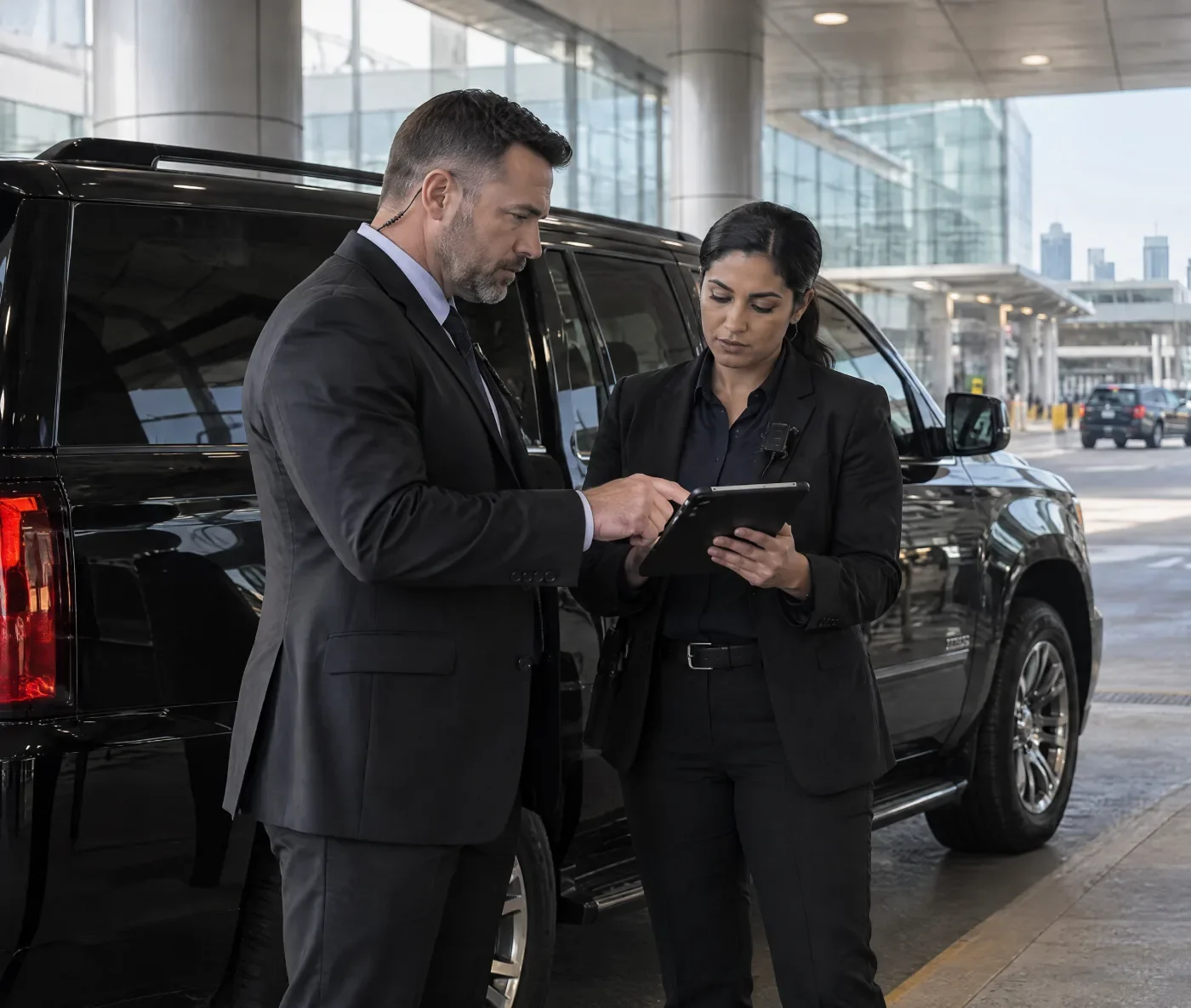
- Move the Principal: secure transportation with vetted security drivers and suitable vehicles.
- Protect in person: licensed operatives, sized to the risk and the itinerary. See Executive Protection.
- Coordinate: with hotel and venue security, the Principal’s office and any travelling security.
- Plan for the unexpected: medical support, the nearest appropriate hospitals, communications that keep working, and a fallback for every movement.
Toronto conditions to plan around
- Major events. Film festival season each September, including TIFF, and other large events fill hotels and venues and close roads.
- Traffic. Congestion, road closures and construction can change journey times sharply, so timings need margins and routes need alternatives.
- Winter. Snow and ice through the colder months affect driving, walking and arrivals, and vehicles and plans should be prepared for them.
Questions to ask a Toronto provider
- Does the company hold an Ontario agency licence, and do the operatives hold individual licences? You can check both online (Ontario).
- What insurance does the company carry?
- Who will lead on the ground, and will they brief your team before arrival?
- How are drivers and vehicles chosen and vetted?
- How will the local team work with your own security lead?
- Can they show experience of similar visits?
- How will your Principal’s information be protected?
How KSS Canada helps
We act as the local partner for private offices, protection companies and visiting Principals: one point of contact, licensed operatives chosen for experience, judgement and temperament to the KSS standard, secure transportation, and advance work before the Principal arrives. See International partners and visiting clients and our case studies.
FAQs
Can our own bodyguard work in Toronto?
Generally, no. Bodyguard work in Ontario needs an Ontario licence, which requires the legal right to work in Canada. The exception is a bodyguard protecting someone working in film and television, who holds a bodyguard licence from their own jurisdiction.
Are bodyguards armed in Canada?
In practice, no. A firearm needs an Authorization to Carry under the federal Firearms Act, and pepper spray designed for use on people is a prohibited weapon.
Do we need a local team for TIFF?
A visiting actor’s own licensed bodyguard may be exempt from Ontario licensing. A local team still provides drivers, advance work, extra cover and knowledge of the venues and the city.
How much notice do you need?
As much as possible. Short-notice visits can be supported, but advance work and the best vehicles and people are easier to arrange early.
Can you meet the Principal at the airport?
Yes. Arrivals are planned as part of the itinerary, whether by commercial or private aviation.
Matthew Beer founded KSS in 2014 and has worked in protective security for more than twenty years, across UHNW households, family offices and corporate Principals in the UK, Canada and internationally.